

 Ask why a recommendation matters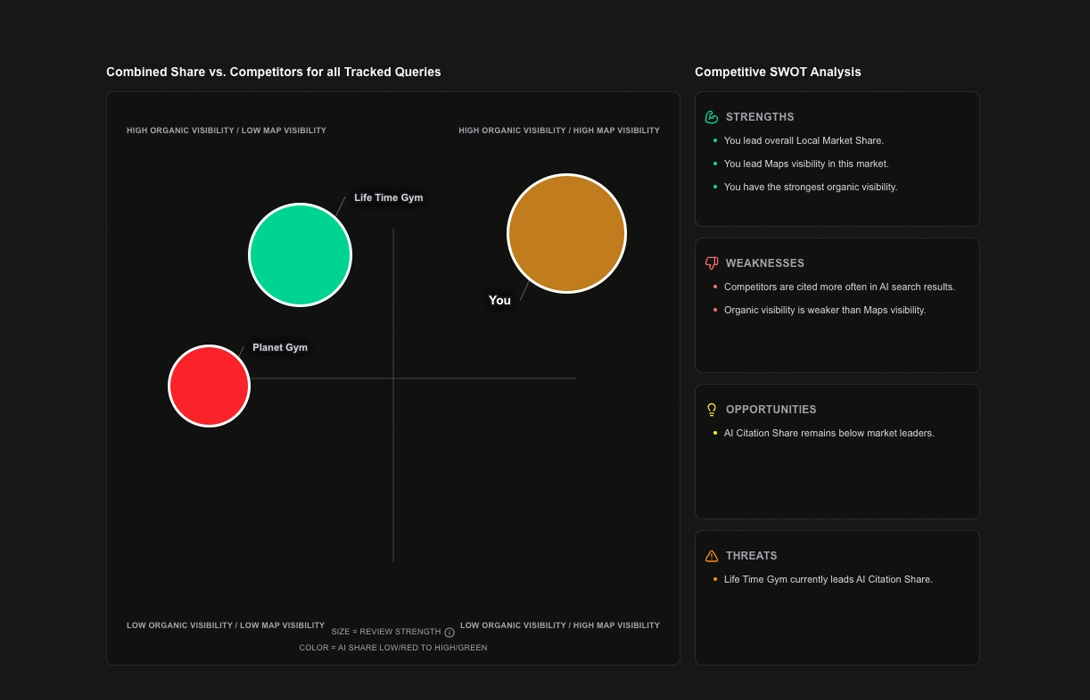
1. Local Landing Page
Your owned source of truth should explain the business, location, services, differentiators, and next steps.
Build pages that rank and convert
See how Google sources local listing information →AGENTIC SEO Platform for local businesses & agencies
Modfyr analyzes your local landing pages, Google Business Profile, reviews, schema, search visibility, and competitors to show what is limiting each location and what to improve next.
Step 1 of 2
Enter your business name and ZIP code. Next, select the correct business to begin your analysis.
Free report. No account or credit card required to begin.
YOUR Local SEO ACTION PLAN, NOW A CONVERSATION
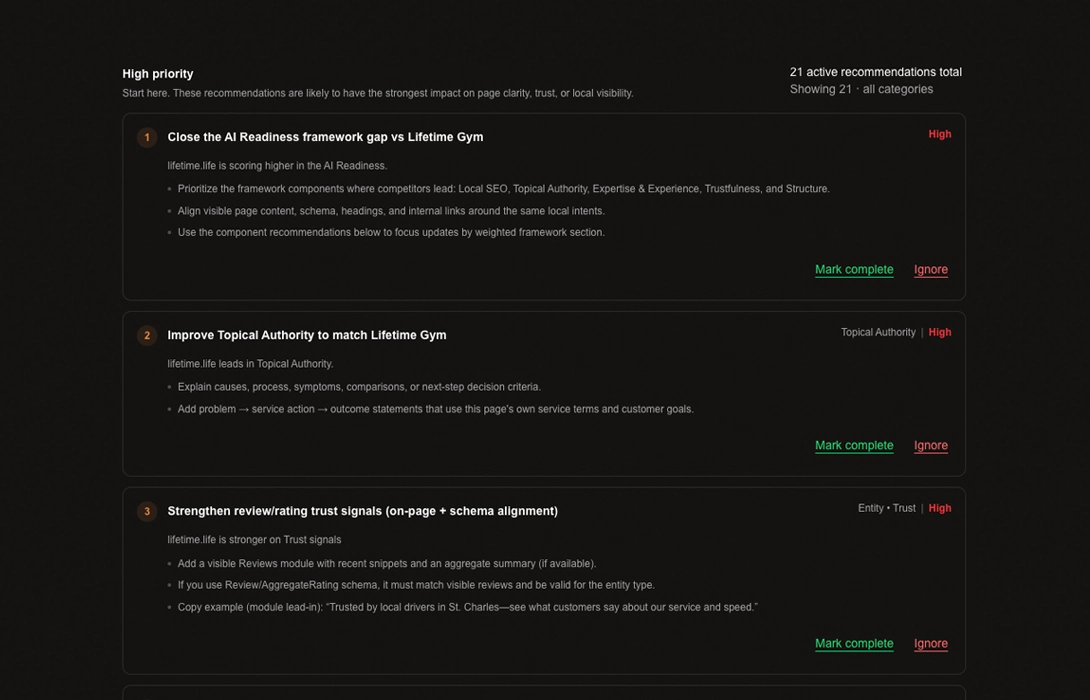
Modfyr's AI Agent turns location-specific SEO findings into a prioritized Action Plan, adding a personalized layer grounded in your local page analysis, scores, search visibility, and competitor insights, making recommended action items simple to understand and easier to implement.
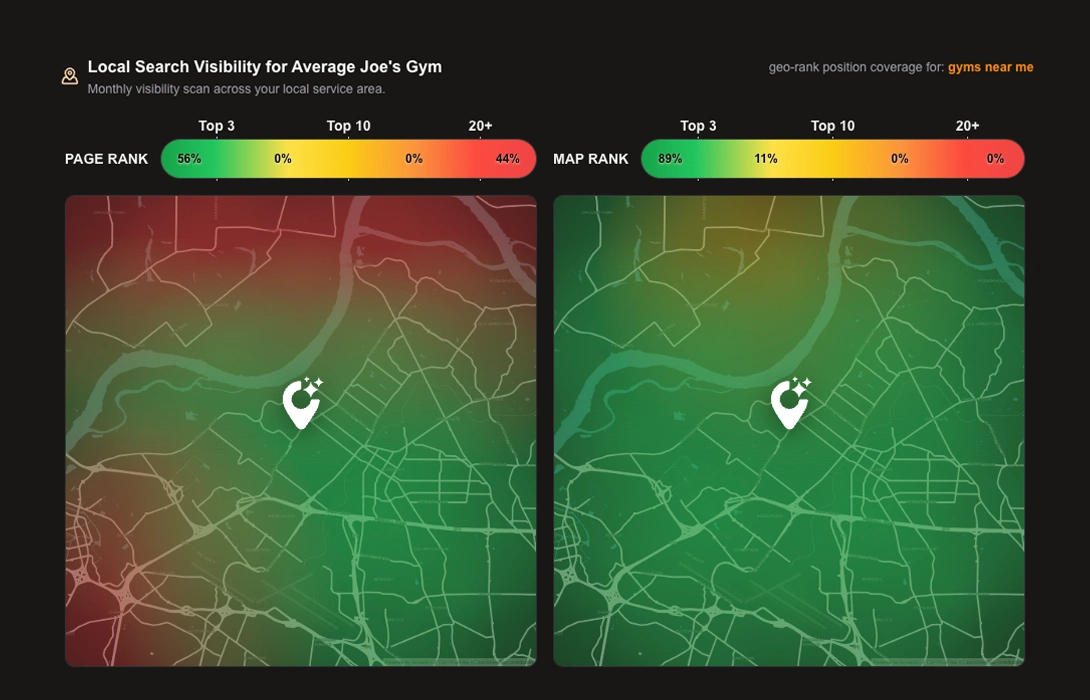
Understand how your business appears across local search results, Maps, and the page ranking behind each query. Modfyr connects rankings with the local-page signals that may be helping or limiting visibility.
Compare your location against businesses competing for the same local searches. Review page strength, rankings, reviews, local signals, and other evidence to identify practical opportunities to close the gap.
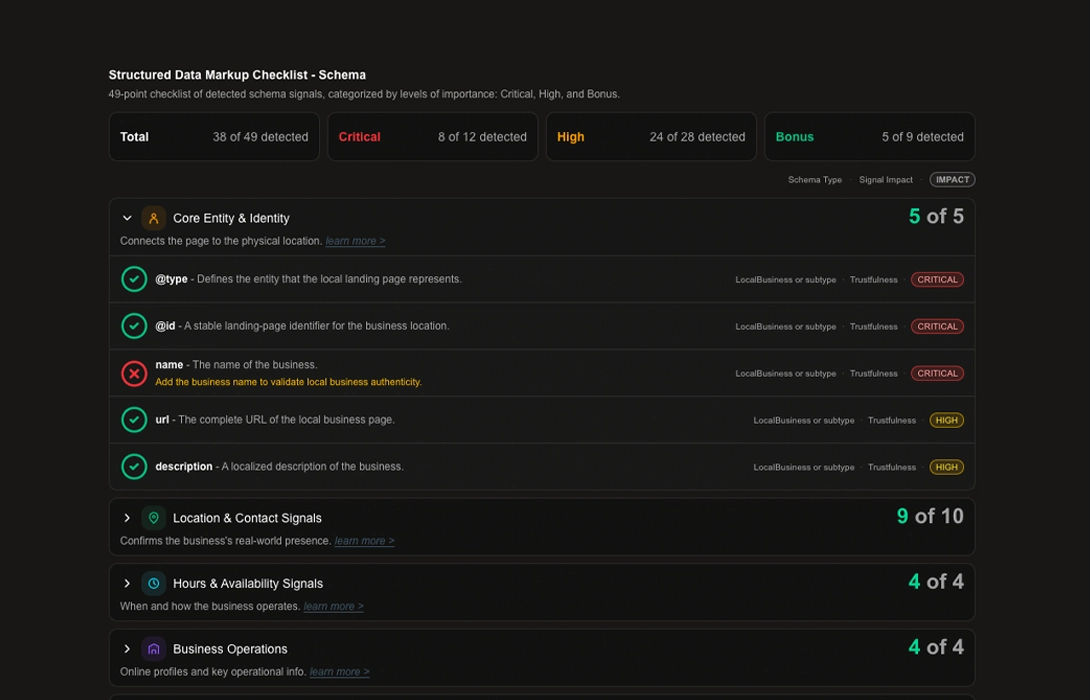
Evaluate LocalBusiness schema, identity, contact information, services, hours, reviews, and other structured signals tied to the local page. Modfyr helps surface gaps between what the page says and what search engines can interpret.
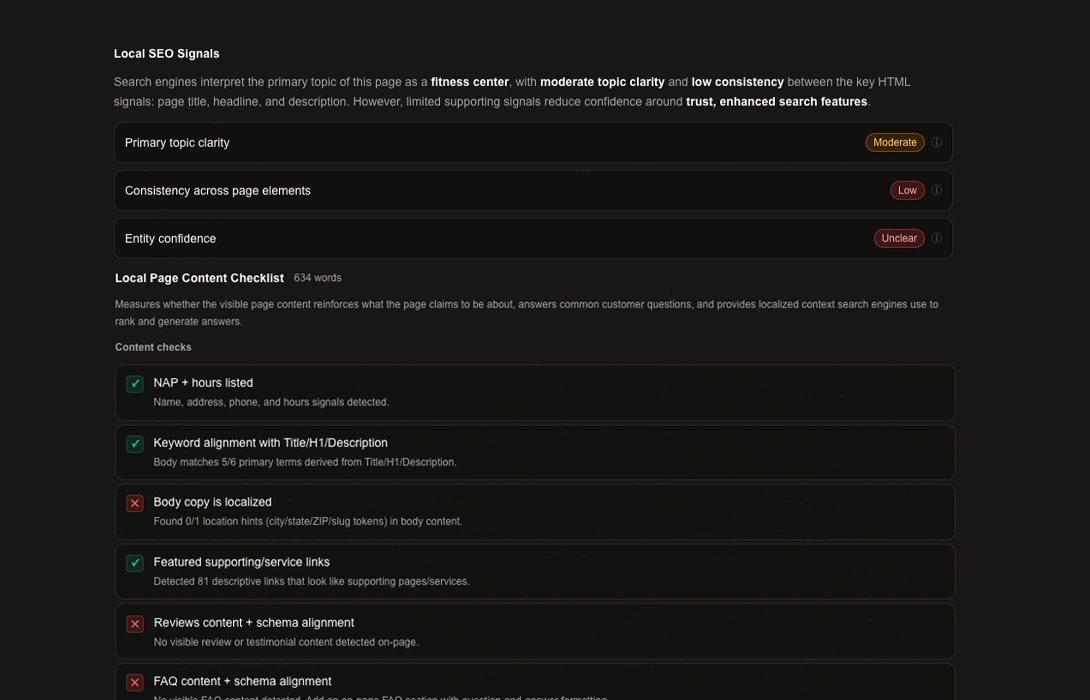
Improve titles, headings, service clarity, location context, trust signals, FAQs, internal links, and other on-page elements that help customers and search systems understand what each location offers.
Bring your local-page findings, search visibility, reviews, schema, and competitor insights into one prioritized Action Plan. Modfyr Agent adds personalized guidance so each recommendation is easier to understand and implement.
The complete picture
The strongest local businesses align information and evidence across three connected surfaces.
Your owned source of truth should explain the business, location, services, differentiators, and next steps.
Categories, hours, contact information, photos, and landing-page alignment support discovery in Maps and local results.
Rating quality, review volume, recency, and customer language provide evidence of real-world experience.
Modfyr evaluates these areas together so recommendations reflect the business’s complete local search presence, not an isolated checklist.
Your owned local foundation
A localized landing page is created for a specific business location or service area. It gives search engines a clear destination to evaluate and gives customers the information needed to choose that business.
For a single-location business, the homepage may serve this role. A multi-location business typically needs a distinct page for each physical location. Service-area pages should provide unique value rather than repeating the same copy with only a city name changed.
Use the local landing-page template and the LocalBusiness schema checklist for practical guidance.
A practical framework
Start with clarity and usefulness. Then strengthen the technical and off-page signals that validate the same information.
Give each landing page a clear purpose instead of combining unrelated services and markets.
Prominent elements should consistently communicate what the page offers.
Display accurate NAP, hours, service areas, and conversion options.
Explain services, process, pricing considerations, timing, availability, and qualifications.
Use the most specific valid subtype and reinforce visible business facts.
Include reviews, credentials, staff expertise, examples, and customer proof.
Connect location pages with services, nearby locations, guides, and contact paths.
Verify that categories, destination, details, and hours support the same entity.
Track relevant local queries instead of relying on one manual search.
Fix clarity, accessibility, identity, and content gaps before lower-value refinements.
Why it matters
Local businesses need to reach the right people within the areas they serve, especially when those people are ready to act.
Local searches frequently happen close to a purchase or appointment. Visibility at that moment creates the opportunity to compete for demand that already exists.
A smaller company does not need national authority everywhere. It needs stronger relevance, trust, and location signals in the communities where it operates.
Accurate details, helpful content, reviews, and a credible local page help customers and search systems feel confident in the business.
The essentials
Local SEO is the process of improving a business’s visibility when nearby customers search for its products, services, or locations. It helps search engines understand what a business offers, where it operates, and why it is a relevant and trustworthy choice for a location-based search.
A traditional search might ask “how often should tires be rotated?” A local search adds immediate geographic intent: “tire rotation near me,” “dentist in St. Charles,” or “best coffee shop open now.” The customer is often deciding which business to call, visit, book, or buy from.
Effective local SEO connects several signals. Your website explains services and expertise. Your Google Business Profile communicates location and operating information. Reviews provide customer evidence. Listings reinforce identity, while structured data helps search engines interpret those details consistently.
To learn more, read how local SEO differs from traditional SEO.
A connected system
Search engines evaluate many signals, but most support four fundamental questions.
Titles, headings, service descriptions, FAQs, internal links, and structured data connect a page to what a customer wants.
Addresses, service areas, local copy, maps, citations, and geographic context establish relevance to the customer’s area.
Reviews, links, citations, brand mentions, and customer proof demonstrate that the business is established and credible.
Accessible, focused, detailed pages give customers and search engines stronger evidence than a thin page or listing alone.
Built to scale
Multi-location SEO requires each location to be distinct enough to rank locally while remaining connected to one trusted brand. The goal is not to repeat the same page for every market. It is to create a consistent system that reflects what is genuinely different about each location.
Give every physical location a dedicated, indexable page with accurate business details, relevant services, original local context, and a clear conversion path.
Align location-page information with Google Business Profiles, listings, reviews, schema, and internal systems without erasing meaningful local differences.
Use location finders, regional pathways, service links, and nearby-location links so customers and search engines can understand the complete network.
Start without the overwhelm
Local SEO spans content, technical setup, listings, reviews, links, and measurement. Beginners do not need to fix everything at once. Establish a reliable baseline and work in the right order.
 Review the page title, H1, description, and service copy
Do not begin by repeating keywords unnaturally or creating dozens of nearly identical city pages. Build one clear, useful, evidence-rich local destination first.
Make local information machine-readable
Visible page content explains your business to customers. LocalBusiness structured data reinforces that information in a machine-readable format, helping search engines understand the business identity, location, hours, contact details, and other location-specific information more consistently.
For multi-location organizations, every location should use accurate markup that represents that specific business location. Schema should support the visible page, not introduce information customers cannot find or verify.
A clearer starting point
Modfyr reviews how important local signals work together and identifies practical opportunities to improve.
Service, location, trust, FAQ, review, and decision-support content.
Consistency across prominent page elements and supporting context.
Identity, location, NAP, reviews, authority, services, FAQs, & navigation.
Presence and consistency of essential business details.
Comparison of website and business-profile identity signals.
Rating quality and review volume as indicators of reputation.
Structured, trustworthy, answer-oriented signals for AI systems.
A real action plan of improvements rather than disconnected metrics.
Find your biggest opportunity
Begin with your business name and ZIP code. In Step 2, choose the correct business and Modfyr will analyze its local page, listing alignment, reviews, schema, and AI readiness.
Step 1 of 2
Enter your business name and ZIP code. Next, select the correct business to begin your analysis.
Free report. No account or credit card required to begin.
Keep learning
See how Modfyr evaluates signals influencing local visibility.
RESOURCEReview structured-data signals for identity, location, services, and trust.
Explore guidance for landing pages, AI readiness, reviews, and schema.
Common questions
Location page SEO is the practice of optimizing a location-specific page so search engines and customers can understand where a business operates, what it offers, and why the page is relevant to local searches. It includes page content, titles and headings, business information, internal links, LocalBusiness schema, trust signals, and alignment with the Google Business Profile.
It helps nearby customers discover the business when they are actively looking for a product or service, supporting qualified visits, calls, appointments, and directions.
Local SEO adds location relevance and signals such as business profiles, reviews, citations, proximity, local pages, and consistent business information.
A useful local landing page should clearly describe the location, primary services, address, phone number, hours, contact options, local context, customer proof, FAQs, relevant internal links, and accurate LocalBusiness structured data that matches the visible page.
For businesses with distinct physical locations, a dedicated page for each meaningful location gives customers and search engines a clear source for location-specific services, hours, contact details, proof, and other local information. Avoid near-duplicate city pages that do not add meaningful local value.
A profile may appear without a strong website, but a useful local page supplies additional relevance, identity, service, trust, and conversion evidence.
No. Search engines also evaluate the linked website, reviews, citations, content, structured data, prominence, and other signals.
Reviews contribute to reputation and confidence. Rating quality, volume, recency, responses, and customer language can support prominence and conversions.
It should evaluate accessibility, content, entity clarity, schema, location details, profile alignment, reviews, trust, internal links, and prioritized opportunities.
Yes. Begin with a business name and ZIP code, select the correct business, and receive a free local-page report without entering a credit card.