
Home
|
Local Search Insights|
Local Landing Page Optimization - PART 1: Using Schema, FAQs, Reviews, and Helpful Content

How to Optimize Local Landing Pages Complete Series Guide SUMMARYPart 1: Using Schema, FAQs, Reviews, and Helpful Content (Current Page)Part 2: Creating Evidence-Rich Local Pages with FAQs, Reviews, and Solution-Oriented ContentPart 3: Connecting Structured Data, Content, and Entity Signals for AI SearchPart 4: How to Implement LocalBusiness Schema for Local SEORESOURCESLocalBusiness Schema Guide to Improve Local Page SEO & AI Visibility The Essential Structured Data Checklist for Local BusinessesLocal Page SEO & AI Readiness Analysis Tool
The rules of local search are changing. For years, ranking well in Google largely meant optimizing page titles, earning backlinks, building citations, and maintaining an accurate Google Business Profile. Those fundamentals still matter, but search has evolved into something much broader. Today's search engines—and increasingly, AI-powered search experiences—don't simply retrieve web pages. They retrieve answers. Instead of returning ten blue links, Google AI Overviews, ChatGPT, Microsoft Copilot, Perplexity, Gemini, and other answer engines attempt to synthesize information from multiple trustworthy sources before presenting a recommendation.
For local businesses, this changes an important question. Instead of asking: "How do I rank my local landing page?"
Businesses should increasingly ask: "How do I become the business AI systems understand well enough to recommend?"
That shift requires more than traditional keyword optimization. It requires creating local pages that communicate clearly with both people and machines. The strongest local landing pages now combine four foundational elements:
Together, these elements create what can be thought of as evidence-rich local pages, which make it easier for search engines and AI systems to understand exactly who you are, what you do, where you operate, and why someone should choose your business. In this guide, you'll learn how these components work together and how to build local pages that are optimized for both traditional local SEO and the future of AI-powered search.
Traditional search engines primarily ranked documents. AI systems attempt to understand knowledge. That difference may seem subtle, but it has significant implications for local businesses. Historically, a local landing page might rank because it contained:
Today, AI systems attempt to answer much more nuanced questions, such as:
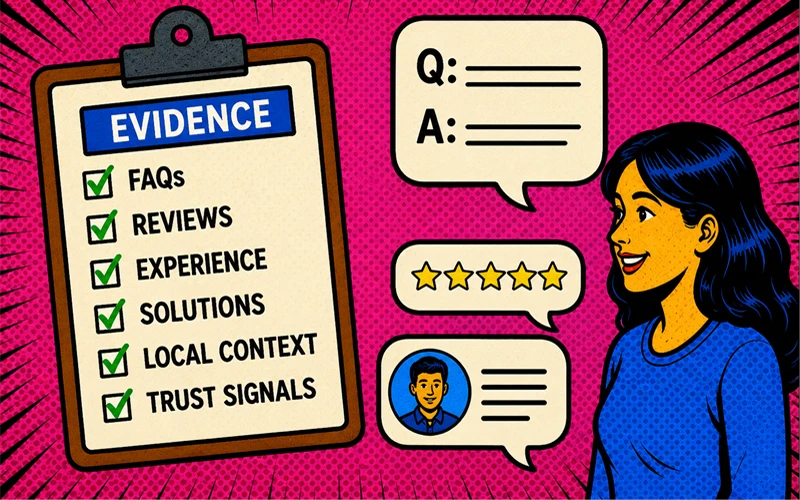
Notice that these aren't simply keyword searches. They're intent-driven questions. To answer them confidently, AI systems look for evidence spread throughout a webpage rather than relying on one isolated ranking signal. That evidence often includes:
The businesses providing this evidence are more likely to be understood—and ultimately surfaced—by AI-powered search experiences.
One of the biggest mistakes local businesses make is creating pages that describe themselves instead of solving customer problems. Consider two examples.
The first says: "ABC Plumbing has proudly served St. Louis for over 25 years."
While this provides useful background information, it doesn't answer a customer's immediate concern.
Now consider this version: "If your water heater stops producing hot water, a licensed plumber can diagnose common issues such as failed heating elements, thermostat problems, sediment buildup, or leaking tanks. In many cases repairs can be completed the same day, while older units may benefit from replacement."
The second example immediately addresses the reason someone searched. That's the difference between business-focused copy and intent-focused content. Search engines—and especially AI systems—reward pages that resolve uncertainty.
Nearly every local search falls into one or more intent categories. Understanding these helps shape stronger content.
The customer wants to learn something. Examples include:
These visitors are looking for education. Businesses that answer these questions establish credibility before a customer is ready to buy.
The customer is comparing options. Examples include:
These searches benefit from:
The customer is ready to act. Examples include:
These pages should reduce friction by providing:
The customer already knows the business. Examples include:
Structured data becomes especially valuable here because it helps search engines retrieve accurate business information.
Many local landing pages still follow an outdated template. They often look something like this: "We proudly serve Springfield with professional HVAC services. Contact us today for all your heating and cooling needs." While technically accurate, this doesn't answer much. AI systems increasingly favor pages that provide useful, complete information.
Instead of filling a page with repetitive city names, consider answering questions such as:
This transforms a page from marketing copy into a practical resource. Helpful content naturally contains the context AI systems need to understand expertise.
One effective way to improve local page quality is to organize content around customer problems instead of simply listing services. For example, rather than creating a section titled:
Expand it into something like:
Each problem becomes an opportunity to explain:
This type of content mirrors how customers naturally search. It also creates numerous opportunities for AI systems to match your page with conversational queries.
Another characteristic of AI-friendly pages is that they don't stop at describing a service. Instead, they anticipate the customer's next question. Imagine someone searching for: "Emergency roof repair after hail." A comprehensive page might address:
This layered approach demonstrates topical depth. Rather than optimizing for one keyword, you're creating a comprehensive resource around a customer need.
Search engines have become increasingly sophisticated at distinguishing unsupported claims from demonstrated expertise.
Statements like...
...offer very little evidence on their own.
Instead, support your claims with information that users, and search engines, can evaluate. Examples include:
Evidence builds credibility -> Credibility supports trust -> Trust influences visibility.
This principle becomes even more important as AI systems synthesize recommendations rather than simply ranking pages.
One useful exercise is to imagine your local landing page being read by someone who has never seen your website before. Could they confidently answer questions such as:
If any of those answers require guessing, your page probably lacks sufficient context. The goal isn't simply to rank, it is to eliminate ambiguity. The more confidently AI systems can understand your business, the more confidently they can reference or recommend it when responding to local search queries.
Part 1: Using Schema, FAQs, Reviews, and Helpful Content
NEXT -> Part 2: Creating Evidence-Rich Local Pages with FAQs, Reviews, and Solution-Oriented Content
Part 3: Connecting Structured Data, Content, and Entity Signals for AI Search
Part 4: How to Implement LocalBusiness Schema for Local SEO
Resource: The Essential Structured Data Checklist for Local Businesses


Start your free trial today—no credit card required.
Still have questions? Please reach out to us at contact@modfyr.com and we'll get back you asap!