
Home
|
Local Search Insights|
Local Landing Page Optimization - PART 2: Creating Evidence-Rich Local Pages with FAQs, Reviews, and Solution-Oriented Content
How to Optimize Local Landing Pages Complete Series Guide SUMMARYPart 1: Using Schema, FAQs, Reviews, and Helpful ContentPart 2: Creating Evidence-Rich Local Pages with FAQs, Reviews, and Solution-Oriented Content (Current Page)Part 3: Connecting Structured Data, Content, and Entity Signals for AI SearchPart 4: How to Implement LocalBusiness Schema for Local SEORESOURCESLocalBusiness Schema Guide to Improve Local Page SEO & AI Visibility The Essential Structured Data Checklist for Local BusinessesLocal Page SEO & AI Readiness Analysis Tool
Many businesses still treat FAQs as an afterthought. They add four or five generic questions near the bottom of a page simply because competitors do. Done correctly, however, FAQs become one of the most valuable content assets on a local landing page. Why? Because FAQs naturally mirror how people search. Compare these two approaches.
Target keyword: Emergency plumber St. Louis
Content: We provide emergency plumbing services throughout St. Louis.
Now compare that to answering real customer questions:
Notice something important? Each question represents an individual search intent. Collectively, they create a page that answers dozens of related searches instead of targeting a single keyword. That is exactly the kind of breadth AI retrieval systems prefer.
A common mistake is writing FAQs from the company's perspective. Examples include:
Instead, write from the customer's perspective. Examples include:
These questions align much more closely with conversational search behavior. They also resemble the prompts users type into AI assistants.
Many FAQ sections contain short, unhelpful answers like:
Do you offer financing? Yes. Technically accurate, but practically useless.
Instead, expand answers enough to eliminate uncertainty. For example:
Financing options are available for many larger projects, including HVAC system replacements, roofing, and major plumbing repairs. Available plans may vary depending on project size and lender approval. During your estimate, we'll review available financing options so you can choose the solution that best fits your budget.
Notice what this answer accomplishes. It provides:
Without sounding like keyword stuffing. Helpful answers create richer semantic signals than one-word responses ever could.
Reviews have traditionally been viewed as trust signals. Today, they also function as content. Every customer review contains valuable information about your business. Reviews often mention:
Collectively, these become another layer of evidence that reinforces your expertise. For example, imagine dozens of reviews mentioning:
Those repeated concepts reinforce what your business is known for. That's useful information for both search engines and AI systems.
Reviews frequently reveal questions your website hasn't answered yet. Imagine several reviews mention: why an old electrical panel wasn't safe.
That suggests an opportunity to add content such as:
Likewise, if customers frequently praise: They helped us understand our insurance claim.
Consider adding:
Reviews become a roadmap for expanding helpful content.
Instead of guessing what customers want to know, let existing customers tell you.
Customers rarely wake up wanting to buy "HVAC maintenance." They wake up because:
The same pattern exists across nearly every industry. People don't search for products. They search for solutions.
Consider these examples.
Instead of: Roof Replacement
Create supporting sections around:
Instead of: General Dentistry
Expand into:
Instead of: Italian Restaurant
Answer questions like:
Instead of: Landscape Design
Address:
Each solution creates another opportunity for AI systems to connect your business with highly specific customer needs.
Anyone can write: We are experts.
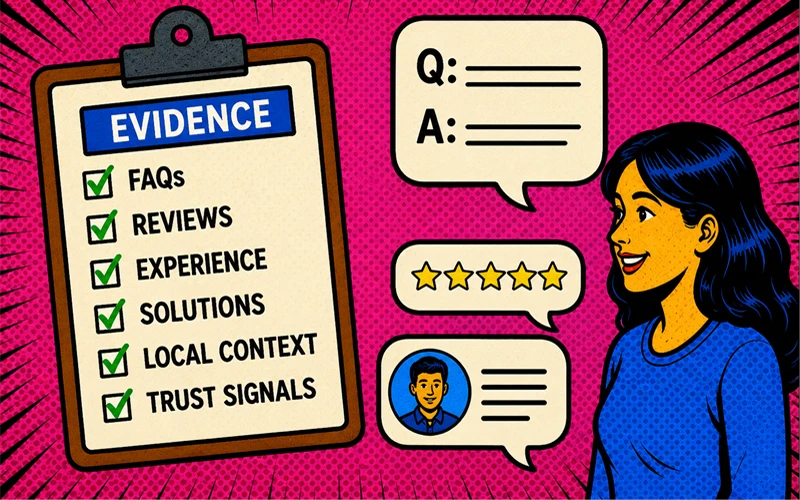
Search engines, and people, want evidence. Instead of claiming expertise, demonstrate it. For example, rather than saying: We provide quality HVAC repairs.
Explain: During a typical diagnostic appointment, technicians inspect refrigerant pressure, electrical components, blower performance, thermostat operation, condensate drainage, airflow restrictions, and overall system efficiency before recommending repair or replacement options.
Notice how much more information that communicates. Without explicitly saying "we're experts," you've demonstrated expertise through specificity. This aligns closely with Google's emphasis on helpful, experience-based content.
AI systems perform better when information is connected rather than isolated. Suppose you mention: We install tankless water heaters.
Expand on that. Discuss:
Now you've transformed a single sentence into an interconnected body of knowledge. This increases topical depth.
Older SEO strategies often revolved around one keyword per page. Modern optimization is increasingly topic-centric.
Instead of targeting: "roof repair Springfield"
Think about everything someone interested in roof repair wants to know. Examples include:
One comprehensive page can naturally answer dozens of related questions. AI systems recognize this breadth.
Every helpful article should connect readers to additional resources. For example, a plumbing page discussing water heaters could link to articles about:
These internal relationships help search engines understand topical authority. They also encourage users to continue exploring your website.
Generic advice is useful -> Localized advice is even better.
Rather than saying: Winter can freeze pipes.
Expand with local context. For example:
In regions where overnight temperatures frequently drop below freezing, exposed pipes in garages, crawl spaces, and exterior walls are particularly vulnerable. Homeowners can reduce risk by insulating exposed plumbing and disconnecting outdoor hoses before sustained cold weather arrives.
This creates stronger geographic relevance without awkwardly repeating city names.
One useful question to ask while writing is, "Would another website, or an AI assistant, feel comfortable citing this paragraph?" If the answer is no, improve it. Pages that earn citations often include:
Those content formats naturally answer questions. And answering questions is exactly what modern search systems are trying to do.
A common misconception is that schema can compensate for weak content. It cannot. Schema tells search engines what something is. Content explains why it matters. For example:
Schema may identify:
But only written content can explain:
Structured data and content reinforce one another. The strongest local pages include both.
Part 1: Using Schema, FAQs, Reviews, and Helpful Content
Part 2: Creating Evidence-Rich Local Pages with FAQs, Reviews, and Solution-Oriented Content
NEXT -> Part 3: Connecting Structured Data, Content, and Entity Signals for AI Search
Part 4: How to Implement LocalBusiness Schema for Local SEO
Resource: The Essential Structured Data Checklist for Local Businesses


Start your free trial today—no credit card required.
Still have questions? Please reach out to us at contact@modfyr.com and we'll get back you asap!