

2026 Local Search Ranking Factors: What We Found Across 148 Real Businesses
The local SEO industry talks constantly about local search ranking factors: website and landing-page optimization, Google Business Profile and listings management, LocalBusiness schema, reviews, content, links, and now AI-powered discovery. None of those areas are necessarily wrong to focus on. The problem for a local business is that it quickly becomes a lot to manage at once.
That is the gap Modfyr is built around. The goal is not to give local businesses another dashboard full of SEO signals. It is to help them understand which parts of their local presence appear to matter most, where they are weak, and what they can realistically improve themselves.
Not another ranking-factor survey. We compared audited local SEO signals from 148 real businesses with their actual Website rankings, Maps rankings and local Search Coverage to see which signals were associated with stronger real-world search performance.
RANK - Better rank at the business location was associated with broader reach: businesses ranking better at their location-center also tended to remain visible across their extended surrounding search area.REVIEWS - Reviews were the strongest single-factor separator: strong-review businesses substantially outperformed weak-review businesses in both website and maps search results.
SCHEMA - With LocalBusiness schema, completeness mattered: businesses with complete schema averaged 62% Total Search Coverage, compared with 39% for Partial and 31% for No schema. See our Complete LocalBusiness Schema Guide for more info.MULTIPLIER -Local SEO signals compounded: businesses with 4–6 strong core signals were 84% likely to rank in organic (website results) Top 10, versus 33% for businesses with 0–1 measured signals.
PUT THE RESEARCH TO WORK
Modfyr Can Help With All of This
Getting started is simple. Enter your business name and ZIP code for a free Local SEO audit. We’ll analyze your website and local search presence and turn the findings into a clear, prioritized report you can actually use.
Step 1 of 2
Get Your Free Local Search Audit
Enter your business name and ZIP code. No credit card required.
Free report. No account or credit card required to begin.
Rank tells you where you showed up. Search Coverage tells you how much of the local market could find you.
A single rank check only tells us how a business performed from one search location. Local Search Coverage measures how consistently that business appeared in search results across its surrounding market area. For this study, we divided each business's market area into a 3×3 grid spanning approximately 72 square miles around the business's location. A business ranking within the top 50 search results at all nine grid points has 100% Search Coverage. We used each business's Google Business Profile primary category + "near me" to standardize one local search query per business for measurement. For example, "Auto Repair Shop" became "Auto Repair Shop Near Me," and "Dentist" became "Dentist Near Me."
Website Search Coverage
Percentage of search grids where the business's website ranked in Organic-search results.
example below = 33% Website search coverage
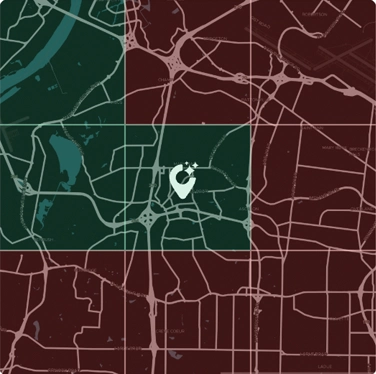
Maps Search Coverage
Percentage of search grids where the business's GBP ranked in Map-search results.
example below = 100% Maps search coverage
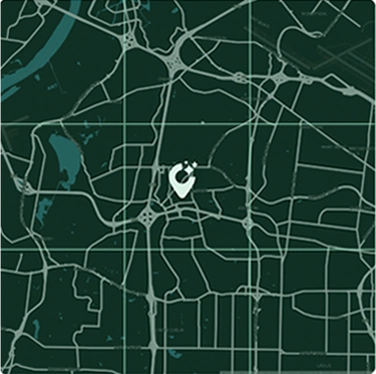
Total Search Coverage
Percentage of Website + Maps total search visibility across the measured local market area.
example below = 67% Total search coverage
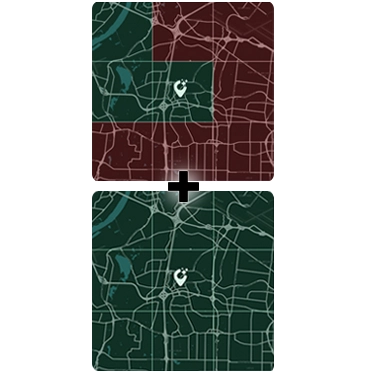
We measured results instead of asking what people think matters
Many local search ranking-factor reports ask SEO professionals which signals they believe have the greatest influence. That perspective can be useful. We wanted to answer a different question: what patterns actually appear in real-world search performance?
We analyzed 148 unique local businesses, measuring Website and Maps rankings from nine search locations across each business's local market. We then compared those outcomes against 11 measurable signals spanning reviews, local page content, LocalBusiness schema, business information and listing alignment.
The result is not a survey of perceived importance. It is a data-driven observational study of which signals—and combinations of signals—were actually associated with stronger rankings and broader local Search Coverage.
Survey-based ranking research
Asks experts what they believe matters, assigns perceived-importance scores, and summarizes professional experience or opinion.
Modfyr real-world study
Measures actual business search results, compares audited signals with observed rank and Search Coverage, and evaluates individual plus multi-signal patterns.
Which Local Search Ranking Factors Did We Measure?
We focused on 11 local ranking-factor categories that Modfyr can consistently audit across a local business's website and associated local search presence.
Helpful, Natural-Language Answers
Whether the page directly answers common customer questions in useful language. Yes with at least six helpful-answer cues or 3+ questions.
Localized Body Copy
Whether the page includes meaningful location-specific language. Yes when at least two available location hints appear in body copy.
LocalBusiness Schema
Whether qualifying LocalBusiness structured data exists and includes usable business identity details. Yes = schema + usable NAP; Partial = schema exists but NAP is incomplete; No = no qualifying LocalBusiness schema.
Supporting / Internal Links
Whether the page links to relevant supporting service or informational pages. Yes when at least two descriptive supporting links are detected.
Word Count of Body Content
A simple content-depth threshold. Yes at 500+ visible words; No below 500.
Keyword Alignment
Whether body copy reinforces the primary terms established by the title, H1 and description. Yes when at least 50% of up to six derived primary terms appear in the body.
NAP + Hours Listed
Whether the page clearly shows business name, address, phone and operating hours. Yes requires all four on-page signals.
Review Strength
Public rating and review volume. Strong = 4.3+ stars and 250+ reviews; Mild = 3.5+ stars below the Strong threshold; Weak = below 3.5 stars or no usable review volume.
Listing Alignment
How closely the page's business identity aligns with its Maps / Google Business Profile listing. Yes = name, address and phone all match; Partial = some match; No = no usable match.
FAQ Content + Schema Alignment
Whether visible FAQ content is substantial and supported by FAQ schema. Yes requires at least two FAQ cues plus detected FAQ schema.
Reviews Content + Schema Alignment
Whether visible review/testimonial evidence is present and review/rating schema is also detected.
Quantifiable, measured visibility, not opinion
Each of the 148 businesses was measured for one category-relevant local query. We captured Website and Maps performance from nine search locations arranged in a 3×3 grid covering roughly 72 square miles around the business.
Rank
The business's center-point Website or Maps position. Rank #1 is best. Businesses not found within the top 50 are treated as rank 51 in average-rank comparisons so unranked results count as poor performance rather than disappearing from the analysis.
Search Coverage
How consistently the business appeared as the search location moved across the local market. Higher is better.
Association, not causation
The study identifies patterns associated with stronger performance. It does not prove that changing any one signal will directly cause a ranking increase.
What is the 2026 Modfyr Local Search Ranking Factors Study?
The 2026 Modfyr Local Search Ranking Factors Study is a real-world analysis of 148 local businesses designed to identify which measurable local SEO signals were most strongly associated with better Website rankings, Maps rankings and broader local Search Coverage.
Rank tells you where you showed up. Search Coverage tells you how much of the local market could find you.
A single rank check answers one narrow question: how did this business perform from this one search location? Search Coverage adds the missing dimension of reach. It shows whether that visibility holds as the searcher moves around the surrounding market.
Website Search Coverage
The percentage of the nine search locations where the business's website appeared in measured organic results.
Maps Search Coverage
The percentage of the nine search locations where the business's Google Maps / Business Profile result appeared.
Total Search Coverage
A combined view of Website and Maps visibility across the measured local market.
Four findings shaped the rest of the analysis
1. Better center rank was associated with broader market reach
The businesses ranking highest near the center of their market also tended to remain visible across more of that market.
2. Review Strength produced the clearest single-factor rank separation
Strong-review businesses were much more likely than Weak-review businesses to rank in the Website and Maps Top 10.
3. Useful, localized content mattered more than raw word count
Localized copy and helpful answers separated performance. Simply crossing 500 words did not.
4. The strongest performance appeared when positive signals stacked together
Businesses with several strong local signals consistently outperformed businesses with only one or none.
Which Local Search Ranking Factors Mattered Most?
This ordering reflects the size and consistency of the observed differences across Website rank, Maps rank and Search Coverage, while also considering whether enough businesses were available on both sides of the comparison. A strong-looking result from a very small group is treated more cautiously than a pattern supported by a broader sample.
11. Supporting / Service Links
Observed separation: Limited
Almost every evaluable page already had descriptive supporting links, leaving little ability to distinguish stronger from weaker performers.
10. Keyword Alignment
Observed separation: Limited
Keyword alignment was also common across the sample. It looked more like a baseline requirement than a meaningful differentiator by itself.
9. Reviews Content + Schema Alignment
Observed separation: Promising
Only 12 businesses met the positive condition, so the result is better treated as exploratory than as a top-tier conclusion.
8. FAQ Content + Schema Alignment
Observed separation: Strong
The positive group performed very well. Only 15 businesses qualified, but all saw significant separation vs businesses without FAQ content and proper schema alignment.
7. 500+ Words of Body Content
Observed separation: Limited · Sample confidence: Broad
Longer content showed only modest coverage differences and almost no average Website-rank difference. Length alone was not a useful quality proxy.
6. Listing Alignment
Observed separation: Moderate · Sample confidence: Broad
Businesses with Partial/Yes alignment averaged 61% Total Search Coverage versus 38% for No. The signal became more compelling when combined with on-page NAP alignment and reviews.
5. NAP + Hours Listed
Observed separation: Moderate to strong · Sample confidence: Broad
Businesses with clear NAP + hours averaged 54% Total Search Coverage versus 29% without it, and their Website rank was substantially better.
4. Helpful, Natural-Language Answers
Observed separation: Strong · Sample confidence: Adequate
Helpful answers were associated with stronger Website rank and broader Search Coverage, and they appeared disproportionately often among the highest-coverage businesses.
3. LocalBusiness Schema
Observed separation: Strong · Sample confidence: Broad
Complete schema averaged 62% Total Search Coverage, compared with 39% for Partial and 31% for No.
2. Localized Body Copy
Observed separation: Strong · Sample confidence: Adequate
Localized copy on the businesses website created one of the study's largest Maps coverage gaps: 87% versus 50% without it.
1. Review Strength
Observed separation: Strong · Sample confidence: Broad
Review Strength showed the clearest single-factor separation in rank performance, especially in Maps.
The strongest pattern was cumulative
The ranking is useful, but no single factor explained performance on its own. The strongest businesses were more likely to get several fundamentals right at the same time.
The better a business ranked near the center of its market, the farther that visibility tended to extend
This relationship was especially clear for Website visibility. A business can rank very well from one point and disappear a few miles away. The strongest performers did both: they ranked high near the center and stayed visible farther across the local market.
Website Search Center Rank & Total Coverage
| Coverage threshold | Businesses | % Ranking in top-10 | Avg. center rank |
|---|---|---|---|
| 90%+ | 11 | 100% | 1.7 |
| 80%+ | 13 | 100% | 1.8 |
| 70%+ | 17 | 100% | 1.9 |
| 60%+ | 24 | 96% | 2.6 |
Maps Search Center Rank & Total Coverage
| Coverage threshold | Businesses | % Ranking in Top-10 | Avg. center rank |
|---|---|---|---|
| 90%+ | 59 | 63% | 9.0 |
| 80%+ | 69 | 55% | 10.4 |
| 70%+ | 72 | 53% | 10.8 |
| 60%+ | 81 | 48% | 12.0 |
Total Search Center Rank & Total Coverage
| Coverage threshold | Businesses | % Ranking in Top-10 | Avg. center rank |
|---|---|---|---|
| 90%+ | 13 | 92% | 2.3 |
| 80%+ | 23 | 87% | 3.3 |
| 70%+ | 39 | 72% | 5.4 |
| 60%+ | 52 | 62% | 6.6 |
How Review Strength Related to Local Search Rankings
Review signals stood out because the pattern appeared in both Website and Maps results. Strong-review businesses were more than five times as likely to rank in the Website Top 10 as Weak-review businesses.
| Review Strength | Avg. Website Rank | Avg. Maps Rank | Website Top 10 | Maps Top 10 |
|---|---|---|---|---|
| Strong | 15.7 | 12.0 | 71% | 56% |
| Mild | 22.7 | 15.8 | 53% | 41% |
| Weak | 44.8 | 38.8 | 13% | 13% |
How Local Page Content Related to Organic Rankings
Several on-page signals were associated with better Website rank, but the strongest patterns were about relevance and usefulness, not simply having more words.
| Signal | Avg. Website Rank: Present | Absent / Weaker | Website Top 10 |
|---|---|---|---|
| Localized body copy | 10.9 | 24.5 | 77% vs 52% |
| Helpful answers | 13.3 | 26.4 | 78% vs 46% |
| NAP + hours | 14.8 | 29.3 | 72% vs 41% |
| LocalBusiness Schema = Yes | 12.3 | 27.4 | 78% vs 44% |
Localized copy had a large Maps reach gap too
Businesses with localized copy averaged 87% Maps Search Coverage versus 50% without it, and 65% versus 36% Total Search Coverage.
500+ words alone did almost nothing for Website rank
Pages with 500+ words averaged Website Rank 21.7. Pages under 500 words averaged 21.5. More content was not associated with better ranking by itself; more relevant and useful content was.
How LocalBusiness Schema, NAP and Listing Alignment Related to Search Visibility
Schema, NAP and listing alignment describe different parts of the same underlying idea: can search systems confidently connect the page to the same real-world business customers see in Maps?
LocalBusiness Schema
If ncluded: Total Search Coverage%
Yes: 62% | Partial: 39% | No: 31%
Partial schema performed much closer to No schema than to complete schema.
NAP + Hours
Businesses with clear on-page NAP + hours averaged 54% Total Search Coverage versus 29% without it.
Listing Alignment
Partial/Yes alignment averaged 61% Total Search Coverage versus 38% for No.
What businesses with 80%+ Total Search Coverage had in common
High-coverage businesses were much more likely to have several local relevance and trust signals in place at the same time. No single signal defined the group, but the pattern was clear.
80%+ Total Search Coverage
83% had NAP + hours, 78% had helpful answers, 70% of evaluable businesses had Partial/Yes Listing Alignment, and 57% had complete LocalBusiness Schema.
90%+ Website Search Coverage
82% had helpful natural-language answers, compared with 33% of the remaining businesses.
Do Multiple Local SEO Signals Compound?
The most convincing result in the study was not one isolated factor. It was the way performance improved as more strong local signals appeared together.
For this comparison, the six-signal core stack includes Strong reviews, LocalBusiness Schema = Yes, Listing Alignment = Yes/Partial, NAP + hours = Yes, localized copy = Yes, and helpful answers = Yes.
| Positive core signals | Businesses | Avg. Website Rank | Avg. Maps Rank | Website Top 10 | Maps Top 10 |
|---|---|---|---|---|---|
| 0–1 | 61 | 32.7 | 21.1 | 33% | 36% |
| 2–3 | 42 | 19.2 | 16.3 | 64% | 43% |
| 4–6 | 45 | 8.8 | 10.2 | 84% | 60% |
Strong reviews + localized copy + helpful answers
All three: Website Rank 4.0, Maps Rank 9.6, 92% Website Top 10, 69% Maps Top 10, 78.2% Total Search Coverage.
None: Website Rank 32.5, Maps Rank 20.8, 32% Website Top 10, 36% Maps Top 10, 25.2% Total Search Coverage.
Strong reviews + Listing Alignment + NAP/hours
All three, n=31: Website Rank 7.4, Maps Rank 9.6, 90% Website Top 10, 65% Maps Top 10, 71.9% Total Search Coverage.
None, n=39: Website Rank 36.6, Maps Rank 26.9, 26% Website Top 10, 26% Maps Top 10, 22.5% Total Search Coverage.
Localized copy + helpful answers
Both: Website Rank 4.2, 94% Website Top 10, 71.6% Total Search Coverage.
Neither: Website Rank 27.7, 44% Website Top 10, 28.8% Total Search Coverage.
Some results were strong enough to notice, but not broad enough to rank higher
Two structured-content signals produced striking performance differences, but their positive groups were small. They are worth watching without treating them as settled conclusions.
FAQ content + FAQ schema
15 positive businesses: Website Rank 7.1, Maps Rank 10.7, 93% Website Top 10, 73% Maps Top 10, 51% Website Search Coverage, 85% Maps Search Coverage and 68% Total Search Coverage.
Other 133 businesses: Website Rank 23.3, Maps Rank 17.1, 53% Website Top 10, 42% Maps Top 10, 24% Website Search Coverage, 55% Maps Search Coverage and 39% Total Search Coverage.
Reviews content + review schema
Only 12 businesses met the positive condition. The broader Review Strength measure was supported by a much larger sample and produced the clearer rank story, so this on-page review/schema signal should remain exploratory.
Some familiar SEO checks were common enough, or weak enough, to tell us very little
500+ words
Website rank was essentially identical above and below the threshold: 21.7 versus 21.5. Content volume alone was not a meaningful separator.
Keyword Alignment
Most pages already passed the check, leaving too little variation to explain performance differences.
Supporting / Internal Links
This signal was also nearly universal, so the study could not isolate a meaningful performance difference from it alone.
AI citations
The positive AI-citation sample was too small to support a reliable audited-factor conclusion. That should be read as an underpowered result—not evidence that the audited signals do not matter for AI visibility.
These are observed patterns, not guaranteed ranking levers
Local search performance is influenced by many factors beyond this audit: proximity, competition, links, brand demand, category density, site authority, business history and more. This study was not designed to isolate every possible cause.
What the data can tell us
Which audited signals and signal combinations were consistently associated with better rank and broader Search Coverage in this 148-business sample.
What it cannot tell us
That adding one signal will automatically create the same ranking change. The findings are best used to prioritize what deserves attention, not to promise a specific outcome.
The practical lesson is not to optimize everything equally
The study did not reveal a single local SEO switch that determines performance. Instead, the strongest businesses tended to combine a clear local page, consistent business information, strong review signals, useful customer-focused content and structured business data. Ranking well at the center of a market was also closely associated with remaining visible farther across that market.
For a local business with limited time and resources, the useful takeaway is prioritization: establish the fundamentals, strengthen the signals that showed the clearest performance differences, and build outward from there.
About Modfyr
Modfyr is a local SEO, search visibility and AI readiness platform built to help local businesses understand what is affecting their visibility, and what to improve next.
Modfyr analyzes the signals businesses can directly influence, including local website and landing-page content, LocalBusiness schema, listing alignment, reviews and business information, then connects those findings with real-world Website rankings, Maps rankings, local Search Coverage and AI-powered discovery.
The goal is to make local search optimization more measurable and actionable, with less time spent working through generic SEO checklists, and more focus on the improvements most relevant to a business's actual search performance.
YOUR Local SEO ACTION PLAN, NOW A CONVERSATION
From analysis to action with Modfyr Agent
Modfyr's AI Agent turns location-specific SEO findings into a prioritized Action Plan, adding a personalized layer grounded in your local page analysis, scores, search visibility, and competitor insights, making recommended action items simple to understand and easier to implement.
 Ask why a recommendation matters
About the 2026 Local Search Ranking Factors Study
What are local search ranking factors?
Local search ranking factors are signals associated with how prominently a business appears in local search results. They can include review strength, local page relevance, business information, structured data, listing consistency, proximity, prominence and other signals search engines use to understand and rank a local business.
How was the 2026 Modfyr Local Search Ranking Factors Study conducted?
Modfyr analyzed 148 real local businesses using one category-relevant local query per business. Website and Maps performance was measured from nine search locations across an approximately 72-square-mile local market, then compared with 11 auditable signals spanning reviews, local page content, LocalBusiness schema, business information and listing alignment.
How is this study different from survey-based local ranking-factor reports?
This study compares audited business signals with observed search performance rather than asking experts to score which factors they believe matter most. It is an observational analysis of real-world Website rankings, Maps rankings and local Search Coverage across the 148-business sample.
Which factor showed the clearest relationship with local search rankings?
Review Strength showed the clearest single-factor rank separation in this study, particularly for Maps performance. The broader analysis also found strong patterns for localized body copy, helpful natural-language answers, complete LocalBusiness schema, NAP + hours and combinations of multiple positive signals.
What does Local Search Coverage mean in this report?
Local Search Coverage measures how consistently a business appeared as the search location moved across its surrounding market. Website Search Coverage measures organic website visibility, Maps Search Coverage measures Google Maps or Business Profile visibility, and Total Search Coverage combines the two.
Does this study prove that these factors cause higher rankings?
No. The study identifies associations between audited signals and observed search performance. Local rankings are influenced by many factors, so the findings are best used to prioritize areas that deserve attention rather than as a guarantee that changing one signal will produce a specific ranking increase.
What should a local business prioritize based on this research?
The strongest overall pattern was cumulative. Businesses performing best were more likely to combine several fundamentals: strong reviews, clear and localized page content, useful customer answers, complete business information, LocalBusiness schema and alignment between the website and local listing.
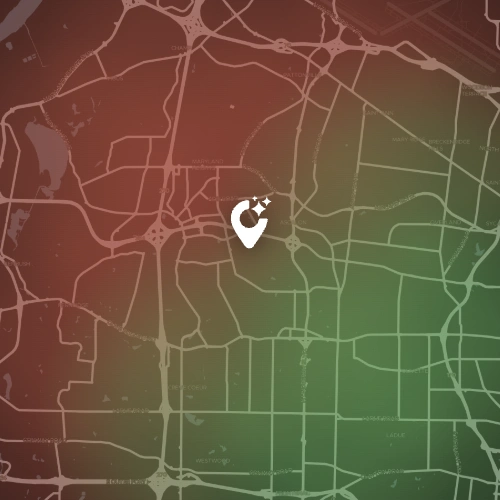
See how far your local visibility actually extends
Modfyr connects Website and Maps rank, Search Coverage and the page signals behind them so you can see where you are strong, and where visibility drops off.