

MODFYR RESEARCH · gbp & website optimization
Google Business Profile Optimal Performance Requires a Strong Website
Brian "BB" Bisges · Modfyr · 2026 Research
Google Maps visibility isn't just a Google Business Profile exercise. An observational analysis of 148 local businesses shows an association between website-related SEO signals and stronger Maps visibility across local search grids.
This research compares local website, listing and structured-content signals with 1,332 geographic Maps Search observations to explore how a website is connected to GBP optimization to support a business's local search presence.
01 · WEBSITE + GBP SIGNALS
Google Maps results are stronger when website factors detected
Measurement of 1,332 local grid search results of 148 unique businesses, broken down by total (out of 7) signals detected on the website listed on each GBP found in results. Chart shows Share of Local Voice percentage (SLV) at these levels: top-3 positions, positions 4–10, positions 11-50, and results with no ranked business (unranked).
Total Grid Coverage is the percentage of total local search grids possible for each tier were a business ranked in positions 1–50. Example, if 20 businesses with 7-out-of-7 signals detected: 9 grid results x 20 businesses = 180 Total Grids. If 160 of those grids had a business ranking in positions 1-50 then the Total Grid Coverage is 89% (160/180).
Key finding: The seven businesses meeting all seven signals achieved 49.2% Top-3 Share of Local Voice and 93.7% Total Grid Coverage, versus 19.1% and 58.1% respectively across all 148 businesses. This is association, not proof of causation.
The seven signals measured
- LocalBusiness Schema
- GBP and Website Schema Alignment
- Strong Review Strength on the GBP listing
- NAP and Business Hours Listed
- Localized Body Content
- Helpful, Natural-Language Answers
- Content + Schema Alignment (Reviews, FAQs)
02 · REVIEW STRENGTH
Reviews remain an important part of GBP visibility
Not surprising, results for businesses with strong reviews performed better than the overall baseline and businesses with mild reviews, and MUCH better than businesses with week reviews, including increased presence in top-3 results and overall search grid coverage increase of 49pp.
Results for businesses with strong reviews had 22% Top-3 SLV and overall 69% local search grid coverage, compared with 8% Top-3 SLV and 20% overall coverage for results for businesses with weak reviews.
03 · NOTABLE INDIVIDUAL FACTORS
The sum of the parts is greater than the whole. No silver-bullet single factors but here's top notable single-factor observations.
Local search performance is not determined by any single website or Google Business Profile factor. The findings above are not meant to suggest that one signal alone is necessarily more impactful than another, or that a particular combination guarantees stronger Google Maps rankings. Business information, content, structured data, reviews and market context work together. The most useful interpretation is to look at the broader pattern while also examining individual signals.
With that context, because we are always asked if any single factor stood out, we're sharing thes five notable individual factors from the study. The figures below compare results where each signal was detected on the GBP's website.
1. LocalBusiness Schema
49 businesses · 441 measured results. Average Maps Rank: 11 (2.6 positions better); Grid Coverage: 79.4% (+32pp); Top-10 Rate: 53% (+26 points). Results for businesses with LocalBusiness schema showed consistent advantages across all measurements.
2. GBP and Website Schema Alignment
32 businesses · 288 measured results. Average Maps Rank: 10 (2.8 positions better); Grid Coverage: 79% (+26pp); Top-10 Rate: 55% (+23pp). Consistency between the listing NAP and website structured data was associated with stronger rankings and broader visibility.
3. Helpful, Natural-Language Answers
54 businesses · 486 measured results. Average Maps Rank: 11 (2.1 positions better); Grid Coverage: 75% (+26pp); Top-10 Rate: 51% (+25pp). Results with local pages that directly addressed customer questions had stronger Maps search visibility.
4. Localized Body Content
31 businesses · 279 measured results. Average Maps Rank: 12 (0.2 positions better); Grid Coverage: 87% (+37pp); Top-10 Rate: 53% (+22pp). The standout relationship was geographic coverage, rather than a large improvement in average rank position.
5. NAP and Business Hours Listed
78 businesses · 702 measured results. Average Maps Rank: 11 (1.5 positions better); Grid Coverage: 71% (+28pp); Top-10 Rate: 45% (+22pp). Results for GBPs with visible business identity and hours information on the website was associated with broader detection across the grid.
How to interpret these findings: These five observations are observational comparisons, not isolated causal effects. Most results included businesses with multiple signals detectedi, and the groups overlap. Market competitiveness, proximity and other characteristics may explain part of the differences. The combined-signal chart above should remain the primary research takeaway.
04 · IMPLICATIONS
A strong website and a strong GBP belong in the same local SEO strategy
Accurate business identity and location information, helpful localized content, aligned structured data and a well-maintained Google Business Profile reinforce a coherent local search presence. The study supports evaluating these together rather than optimizing a GBP in isolation.
Methodology
148 businesses, nine nodes each, 1,332 query-at-location Maps observations. A “map search result” here is one measured grid observation, not a Google-reported impression or distinct searcher. Every node is classified Top 3, 4–10, 11–50 or Unranked. Coverage equals ranked nodes divided by all nodes. Results are observational, and proximity, category and competitive environment were not controlled.
Further reading: 2026 Local Search Ranking Factors, LocalBusiness Schema, and GBP and Website Alignment.
05. Hassle-free options to help you get started
Start free. Add deeper analysis when you need it.
Every path begins with a free local SEO audit. Paid plans expand the depth of AI Readiness, search analysis, competitive benchmarking, and ongoing guidance.
unlock your local search potential

Free
1 Project | Included per project:
- Local website audit
- Content analysis
- GBP alignment
- Review strength score
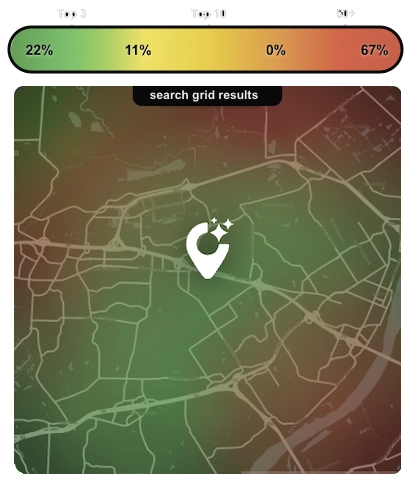
- Local search performance (x1 query)
- Local search grid (x1 query)
- Local AI share report (x1 query)
- 5-point Schema markup analysis
- Prioritized action plan (limited)
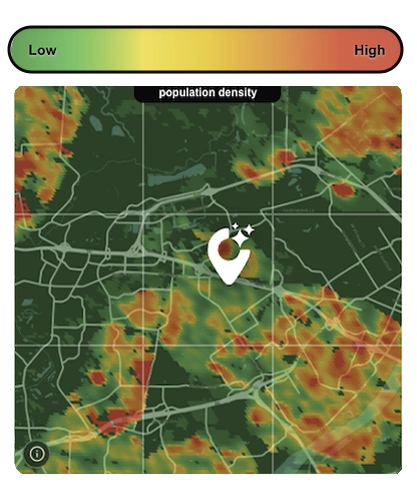
- Service area population density analysis
- Modfyr AI agent personal assistant
AI Readiness
3 Projects | Included per project:
- Local website audit
- Content analysis
- GBP alignment
- Review strength score
- Local search performance
- Local search grid (x4 queries)
- Local AI share report
- 49-point Schema markup analysis
- Prioritized action plan
- Service area population density analysis
- Modfyr AI agent personal assistant
Compete
Everything in AI Readiness +
3 Competitor Projects | Included per project:
- x2 Competitors per project
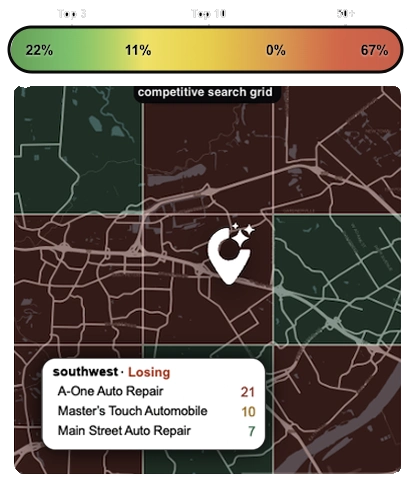
- Competitive local search grid
- Competitive local search performance
- Competitive population density analysis
- Competitive SWOT analysis
- Competitive AI share report
- Competitive action plan
Google Business Profile, Website SEO and Maps Research
Can a website influence Google Maps visibility?
This observational study found that website-related local SEO signals were associated with stronger Google Maps visibility. A website can reinforce business identity, location relevance and useful service information, but Maps performance also depends on the Google Business Profile, proximity, competition and other factors.
How many businesses and Google Maps observations were analyzed?
The research examined 148 local businesses across nine geographic search points each, producing 1,332 query-at-location Maps observations. These are measured grid results, not Google-reported impressions or unique searchers.
Which website signals were associated with stronger Maps performance?
The study highlighted LocalBusiness schema, website and GBP information alignment, helpful natural-language answers, localized body content, and visible NAP and business hours. Review strength was also associated with substantial differences in geographic Maps visibility.
Why does website-to-Google Business Profile alignment matter?
Consistent names, addresses, phone numbers and relevant structured data help present a coherent business identity across the website and Google Business Profile. In this sample, aligned website and listing signals were associated with broader Maps grid coverage and stronger observed rankings.
How were Google Maps rankings and Search Coverage measured?
Each business was measured at nine geographic grid points. Outcomes were grouped as Top 3, positions 4–10, positions 11–50, or Unranked. Search Coverage is the proportion of measured points where the business ranked within the evaluated results.
Does adding LocalBusiness schema or localized content guarantee higher Maps rankings?
No. The observed differences do not show that adding any one signal causes a ranking improvement. Several signals co-occurred, and proximity, business category, competitive conditions and other influences were not controlled.
What should a local business improve first?
Begin with accurate, consistent business details across the website and Google Business Profile. Review helpful location-specific content, service information, visible hours, relevant LocalBusiness structured data and reputation signals, then measure visibility across the same local search grid.