AI Readiness
SEO

SEO vs Local SEO vs AI Search Optimization: What’s the Difference?

SEO vs Local SEO vs AI Search Optimization: What’s the Difference?

Search optimization has expanded beyond traditional search engines. Today, businesses must optimize their websites for these distinct but related systems:

• Traditional SEO

• Local SEO

• AI Search Optimization

While these approaches share many foundational principles, they address different types of search behavior and rely on different signals. Understanding how they work together helps businesses ensure their content is visible in both traditional search results and AI-generated answers.

What Is Traditional SEO?

Traditional SEO focuses on improving a website’s ability to rank for general search queries across search engines such as Google and Bing.

These queries are often informational or commercial in nature, such as:

• “best project management software”

• “how to repair brake pads”

• “digital marketing strategies”

Traditional SEO primarily focuses on signals such as:

• keyword relevance

• backlinks and domain authority

• technical website performance

• content depth and topical authority

These signals help search engines determine which pages are most relevant for a given search query.

What Is Local SEO?

Local SEO focuses on helping businesses appear in search results when users are looking for nearby services.

Examples of local search queries include:

• “oil change near me”

• “dentist in Chicago”

• “pizza restaurant downtown”

Because these queries include geographic intent, search engines prioritize signals that confirm a business’s location and services.

Key Local SEO signals include:

• LocalBusiness structured data

• business name, address, and phone consistency

• location landing pages

• review and reputation signals

• proximity to the searcher

Businesses that leverage modfyr's local SEO solution to optimize these signals improve their chances of appearing in local search results and map listings.

What Is AI Search Optimization?

AI Search Optimization (aka GEO, AEO, LLMO) focuses on improving the likelihood that content will be used as a source in AI-generated answers.

Instead of presenting lists of websites, AI-powered search systems increasingly generate summaries or recommendations by interpreting information from multiple sources.

AI search optimization emphasizes signals that help machines understand and trust information, including:

structured data markup

• entity clarity

• conversational question-and-answer content

• trust signals such as reviews and reputation

Modfyrs local AI Readiness solution helps businesses evaluate whether their pages contain the signals needed for AI systems to interpret and cite them.

How SEO, Local SEO, and AI Search Optimization Work Together

Although each approach targets different systems, they share a common foundation.
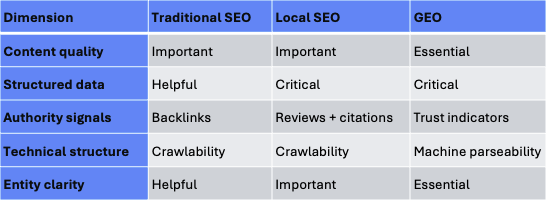
chart showing foundational dimensions of traditional SEO, local SEO, and GEO-AI search optimization.
Foundational dimensions of traditional SEO, local SEO, and AI search optimization.

Businesses that optimize all three areas create content that performs well across both traditional search engines and AI-driven discovery platforms.

Why Businesses Should Optimize for All Three

Consumers increasingly use multiple types of search experiences to find businesses. A customer might:

1. Search Google for nearby services

2. Ask an AI assistant for recommendations

3. Compare options online before visiting a business

Businesses that combine Local SEO optimization, traditional SEO authority, and AI search readiness are far more likely to remain visible throughout this discovery journey.

Tools within the modfyr solutions platform, including tools for local SEO, AI readiness, and competitive reporting, help businesses evaluate and improve these signals.

The Future of Search Optimization

Search is evolving rapidly as AI becomes more integrated into how information is delivered.

Businesses that strengthen both traditional optimization signals and machine-readable information will be best positioned to remain visible as search continues to change.

Understanding how SEO, Local SEO, and AI search optimizationwork together is the first step toward building a strategy that performs across both search engines and AI-powered search systems.

Ready to unlock local growth for your business?

Start for Free

Start your free trial today—no credit card required.

Frequently Asked Questions

How is Modfyr different from other SEO and AI Search Optimization tools?

Many local SEO platforms focus primarily on listings management, citation consistency, review monitoring, and Google Business Profile optimization. While these factors remain important, they represent only part of what search engines and AI systems use to evaluate local businesses.

Modfyr expands beyond listings and reviews by analyzing the content, page signals, entity clarity, LocalBusiness schema, trust indicators, and optimization opportunities that influence both local search visibility and AI search readiness. The result is a more complete view of how search engines and AI systems understand your business and where opportunities for improvement exist.

Does modfyr only evaluate landing pages and website optimization?

No. Local search performance depends on more than website content and technical SEO. Search engines also consider factors such as listings consistency, review strength, business prominence, proximity, and citation signals when determining local visibility.

In addition to evaluating on-page optimization, Modfyr incorporates Listings Alignment and Review Strength into its analysis to help provide a more complete picture of local search performance.

What factors most influence local search visibility?

While search engines evaluate many signals, some of the most important include technical accessibility, LocalBusiness schema, entity clarity, content relevance, trust signals, service coverage, and overall page quality. Together, these signals help search engines determine when and where a business should appear in local search results.

Why is LocalBusiness schema important for local search?

LocalBusiness schema helps search engines understand important business information such as location, services, hours, contact details, and business identity. Strong schema markup can improve entity understanding and reinforce local relevance across search engines and AI-powered search experiences.

How does local search analysis support AI search optimization?

AI systems rely on many of the same signals used by search engines to understand businesses and websites. Strong content, entity clarity, trust signals, and structured data can improve how accurately AI systems interpret, reference, and surface local businesses within AI-generated answers.

What does Modfyr's Local Search Analysis evaluate?

Modfyr evaluates six core categories that influence local search performance: Accessibility, Entity Clarity, Trust Signals, Structured Data, Page Depth, and Content Helpfulness. These categories help identify optimization opportunities that may improve local search visibility.

Can Modfyr identify local search optimization opportunities?

Yes. Modfyr analyzes local search signals across content, page structure, technical accessibility, and LocalBusiness schema to identify areas that may be limiting search visibility and provide prioritized recommendations for improvement.

Who should use Modfyr's Local Search Analysis?

Modfyr is designed for local businesses, multi-location brands, agencies, marketers, and SEO professionals who want to better understand the factors influencing local search visibility and identify opportunities to improve search performance.

Does Modfyr support multi-location businesses?

Yes. Modfyr can evaluate location-specific pages and local search signals, making it useful for businesses that manage multiple locations and want to improve visibility across local markets.

How often should local search signals be reviewed?

Local search signals should be reviewed regularly, especially after website updates, content changes, location additions, or schema updates. Ongoing monitoring helps ensure search engines continue to receive accurate and complete information about the business.

What is local search analysis?

Local search analysis is the process of evaluating the factors that influence how prominently a business appears in local search results. This includes content quality, technical accessibility, LocalBusiness schema, entity signals, trust indicators, and other factors that help search engines understand and rank a local business.

How does local search analysis differ from traditional SEO audits?

Local search analysis is the process of evaluating the factors that influence how prominently a business appears in local search results. This includes content quality, technical accessibility, LocalBusiness schema, entity signals, trust indicators, and other factors that help search engines understand and rank a local business.

Still have questions? Please reach out to us at contact@modfyr.com and we'll get back you asap!